
By Melanie Ralph.
Last year I had an amazing opportunity to take part in the University of Adelaide’s filming for their Classroom Confidence Micro-credentials course. These continuing education courses are free and self-paced, focusing on classroom management, explicit teaching, and phonics.
It was a pleasure to meet the team, which was led by Joanna Anderson, Associate Professor in Education at the University of Adelaide. To register for the courses, you can start by clicking here. Note that enrolment takes a few days.
The video that I feature in includes footage of me using an explicit teaching model for a Year 9 English lesson on embedding quotes into analytical writing. It was part of our unit on Animal Farm by George Orwell. Some of my interview also covers how I use data in my planning.
When I completed the short course, I was impressed by the professional and sophisticated presentation and the high-quality content offered. Even if explicit teaching is already part of your repertoire, you’ll find useful resources here with clear and engaging graphics. You will also get to see teachers from across Australia reflecting on their use of explicit teaching in the classroom.
I’m proud to be featured in this project, but it got me thinking about the scathing critique I wrote back in 2021 about Noel Pearson and his devotion to explicit teaching (or direct instruction). One may wonder why, after critiquing some of the unhelpful discourses about explicit teaching in 2021, am I here in 2025 in an instructional video showing how I use it in my classroom?
I pondered: could the course content be indicative of the fact that teachers aren’t so inquiry-led in Australian classrooms that they leave “kids to figure it out for themselves,” as Noel Pearson fears? Could the ‘what works best’ in schools debate, which describes binaries or “either/or” options when it comes to teaching methods, actually erode the professionalism of Australian teachers who seek a more nuanced conversation about pedagogy?
The binary typically pits explicit teaching or direct instruction against discovery or inquiry learning. Alan Reid, Emeritus Professor of Education at the Centre for Research in Educational and Social Inclusion at the University of South Australia, provides a succinct summary of the two approaches here:
“Explicit teaching is a structured sequence of learning led by the teacher, who demonstrates and explains a new concept or technique to students who then practise it. It is sometimes described as a process that moves from ‘I do’ through to ‘we do’ and ‘you do’. Inquiry-based teaching is used as a catch-all term for models of teaching that are student-centred and involve the students, guided by the teacher, creating essential questions, exploring and investigating these, and sharing ideas to arrive at new understandings.”
Most teachers would agree with Allan Luke that “explicit instruction in its various forms is a necessary part of an effective school-level response.”
So far, so good. So, what’s the problem?
Like many others, Dr Jill Brown, Associate Professor in Mathematics Education at Deakin University, believes that “the idea that there is one best way to teach all students is not evidence-based and warrants scrutiny.” Likewise, Reid points out that “creating simplistic binaries in a field as complex and nuanced as teaching and learning impoverishes the educational debate.”
Indeed, claims by politicians and journos, (who are, it bears mentioning, not teachers) that we should replicate explicit teaching everywhere if we want “grim” Naplan results to “soar” and to reverse our “declining” PISA scores, warrant further – dare I say it – inquiry.
Often referred to in the media as an “old-school” approach, Trisha Jha, Research Fellow at the Centre for Independent Studies (CIS), assures us an explicit teaching model is “not back to basics but back to what works best.” Dr Jenny Donavan, the CEO of the Australian Education Research Association, is so sure that explicit teaching ‘works best’ that she says “’there are no cracks’ for students to fall through under the new method.”
Now that’s confidence. Donavan does acknowledge that “it will take time to see results reflected in test scores.” Ah, standardized test scores, that’s what it’s all about, right? Well, not quite. Dr Jen Jackson, Adjunct Associate Professor of Education Policy at Victoria University, points to the fact the most effective schools aren’t necessarily the highest academic performers.
The ongoing ‘what works best’ saga was once again fuelled last year after the success in Naplan scores at a cluster of Catholic schools in Canberra who adopted the Catalyst high-impact teaching program, and it’s a sad tale when the success of some schools – notably private schools in a state with the highest average disposable household income in the country – is used to cast harsh judgements on both public schools and teachers.
For instance, it was reported that fifty teachers gave up three days of their holidays to be coached by Dr Lorraine Hammond and her team from Edith Cowan University. One article points out that of the fifty teachers “none [were] from government schools” and “in light of the recent literacy and numeracy inquiry, perhaps some should be attending.”
Ouch. Can you blame them for not cutting their holiday short when you consider that Australian teacher hours are high by international standards?
Contrary to what adherents of strictly explicit-based teaching fear, Sally Larson, lecturer in education at the University of New England, observes that there has not been a long-term decline in Naplan results and that “the panic over Naplan is media spin.” She writes that the inaccurate fixation on declining Naplan results – “with the relentless annual reports of crises and catastrophes in our schools” – is “not healthy or helpful.”
While schools have every right to celebrate what they consider to be success, why must it be embellished with condescending and contentious jabs at others or infused with a rigid view about pedagogy?
For example, Teachers Professional Association of Australia national secretary Edward Schuller (who fascinatingly has no teaching experience) interpreted the Naplan success in the Canberra schools as the “death knell of student-led learning,” declaring that “we hear too much about 21st century skills.”
By this I assume he is referring to capabilities like those listed on the Queensland Curriculum and Assessment Authority overview of 21st century skills, such as critical and creative thinking, personal and social skills, digital literacy, collaboration and communication, to name a few. Are these capabilities part of the “clutter” Schuller believes teachers need to, in his own words, “cut through”?
Even Jha, of the CIS, seems to share Schuller’s confusion about the importance of these capabilities, writing that “despite a popular belief that “collaboration” (whatever that is) is vital to help student learning, it also means more opportunities for distraction.”
It’s all sounding a little ‘old-school’ to be honest, and truly puzzling given that once again, the World Economic Forum’s Future Jobs Report lists a “combination of cognitive, self-efficacy and interpersonal skills within the top five” skills employers seek in the workforce.
So, when I read that schools are being pressured to restrict important practices like collaboration, I seriously wonder why on earth would schools seek to deprive students from opportunities to develop the kinds of critical skills that they will need when they enter the work force and find that most jobs require complex, nuanced skills that cannot be replicated by AI and other automated technologies?
My concern that schools risk limiting opportunities for students’ development is mirrored in the McKinsey Global Institute’s ‘Jobs lost, jobs gained’ report which explains how the future of AI and automation will require a shift in the skills and capabilities of workers, “requiring more social and emotional skills and more advanced cognitive capabilities, such as logical reasoning and creativity. Workers of the future will spend more time on activities that machines are less capable of, such as managing people, applying expertise, and communicating with others.”
Literally nobody is arguing against the importance of “foundational basics”, as Schuller puts it, but clearly, to rely upon one approach to teaching all students, all the time, would be to leave them unprepared for the world beyond Naplan.
So, in other words, while no one is denying the importance of literacy and numeracy, there’s more to education in 2025 than Naplan scores.
In some good news, the 2022 PISA Creative Thinking assessment showed that Aussie teens are among the most creative thinkers in the world; ranking fourth out of 64 participating countries in creative thinking. But did you catch the positive headlines about this? Neither did I, because it was barely reported on and didn’t make front page headlines in the same way that scathing criticism of Naplan results has.
What did make the news last year was New South Wales becoming the first state to “mandate methodology.” I refer here to NSW teachers being “ordered” to partake in explicit teaching professional development. The move was described in the media as a “shake-up,” but is it really a ‘shake up’ to require teachers to clearly explain, demonstrate, and model new concepts? Like most teachers, I was under the impression this was the job.
As a teacher of 17-years who has taught in both private and public schools around the world and in a number of low-socio economic schools, I’ve learned something that policy makers seemingly fail to recognize: that mandating all teachers to use one approach across all schools all the time is like trying to herd cats. It’s not because teachers don’t want to build their skills and have productive conversations about pedagogy – most do (preferably not during holidays) – they are just swamped by admin demands, confronted with “the monster of datafication,” and are rightly wary of silver-bullet approaches and patronizing media coverage.
Joanne Sau-Ching Yim and Priscilla Moses write that “observers in educational change have noted the global pattern of reform overload and teachers’ work intensification.” This, in turn, has “sapped the energy and motivation of those responsible for implementing the reforms.”
So when click-bait headlines about explicit teaching mandates ask “will staff comply?” or when people like Jha of the CIS encourage parents to “test” how well their child’s school “follows evidence” by quizzing their child about the desk formation in their classroom, it’s easy to see why teachers feel demoralized by a lack of professional trust and respect in the community. It’s also indicative of the long-running, disproportionately negative media coverage of Australian teachers.
Nicole Mockler’s Constructing Teacher Identities, examined media discourses around teachers and looked at 65,000 print media articles published in Australia from 1996 to 2020. Unsurprisingly, Mockler found there is a “large appetite on the part of journalists, editors, and, presumably, readers of newspapers for stories about teachers and schools” and that “far more column inches were devoted to teachers” than to “accountants, public servants, nurses, lawyers and doctors.” Clearly, education has become fetishized by the media in an unhealthy, toxic way, which has led to an open forum to sling mud at teachers (even getting criticized for being “lavished” with gifts from students at the end of the year).
One such example of toxic depictions of teachers, is how Noel Pearson has filled many column inches making his “explicit plea” (get it?) for all schools to adopt explicit instruction. In doing so, he has blamed falling PISA scores in Australia on “all of the social constructivists in education” and the teachers “pursuing the dream of John Dewey and Lev Vygotsky.”
I just don’t buy it, i.e., Pearson’s claim that there is such a direct (read: simplistic) correlation between teachers who are inspired by Dewey and Vygotsky and declining test scores. Likewise, when journalists claim that university lecturers are teaching education students to “fear” explicit instruction, I just don’t buy it.
My scepticism comes from the reality that, amidst all this noise, there has never been any evidence showing that teachers or teacher educators don’t support or enact explicit teaching. Could the debate about the ‘best’ teaching strategy be what Tom Mahoney calls a “metaphorical straw teacher,” i.e. that there is in fact no evidence that teachers are not currently using evidence-based approaches?
Could it be, that educational outcomes have more to do with the rise in child poverty or the fact that most Australian children read less and spend more time on screens than is recommended (this has been negatively linked with academic performance) than simply what teachers are, or aren’t doing, in the classroom? What about the youth mental health crisis, the increase in the prevalence of school refusal, the fact our class sizes are “bursting at the seams”, or indeed the dire inequality that is now “baked” into our education system?
But nah, as Jha confidently assures us, the real problem is desk layouts, “the pursuit of untested educational fads,” and that we’ve simply been “fed meaningless clichés or told the issue is a lack of funding.”
Again, I just don’t buy it.
Perhaps most baffling is her view that “it is the role of education policymakers to help” teachers “be better at their jobs.” I doubt that many Australian teachers would share her view. Why on earth would they seek to outsource their professional learning to policymakers, many of whom have never taught in a school?
Michael Fullan and Andy Hargreaves assert that this kind of top-down staff development embodies “a passive view of the teacher, who is empty, deficient, lacking in skills, needing to be filled up and fixed up with new techniques and strategies.”
But what concerns me even more than Jha’s nebulous ‘educational fads’ claim, or Noel Pearson’s recurrent nightmares about inquiry learning, is the fact that this year 4000+ Australian classrooms will be without a teacher. Actually, experts say this figure is far lower than what the reality will be.
That’s right: students won’t have either a Dead Poets Society-style, Dewey-dreamer like Robin Williams, nor will they have a fact-deliverer like the economics teacher in Ferris Bueller’s Day Off.
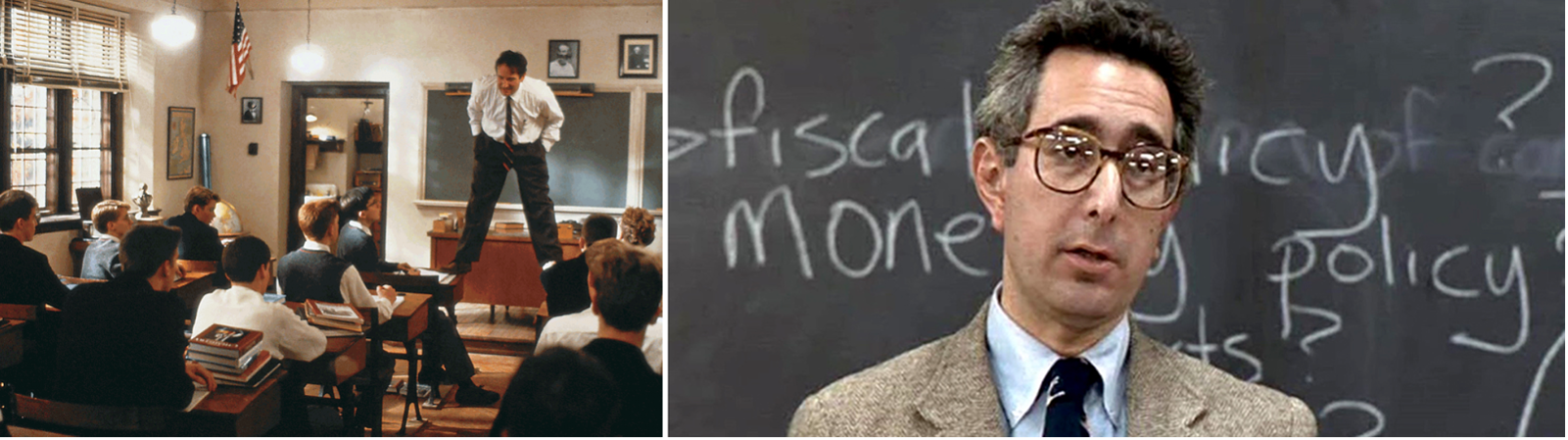
They will have no one. Teachers are leaving in droves and fewer people are signing up to even begin a teaching degree. Up to 50 per cent of newbies intend to tap out within 5 years and even experienced teachers are leaving.
Can I attribute this directly to the ‘what works best’ narrative? No, because just as teaching practices and educational outcomes cannot be solved with one approach, the issue of teacher retention is not so simplistic. In addition to the ‘what works best’ debate, research tell us that the lack of respect for teachers in the public discourse and the “lack of professional autonomy” has been found to be the “primary reason for teachers leaving the profession, even more so than inadequate salaries.” Conversely, we know that “providing teachers with greater autonomy not only acknowledges their professional expertise but is also likely to contribute to teacher retention.”
Like me, Tom Mahoney wonders how we can “expect to entice more to enter the teaching profession with all this smog.” When teachers are so regularly patronised and undervalued in the media, and the community more broadly, is it any wonder that they might be scrolling through Seek in a staff meeting or have a Flight Centre tab open on their glitchy education department computer, perpetually hovering one click away from taking leave with no intention of coming back?
Fullan and Hargreaves remind us that “teaching is not just a collection of technical skills, a package of procedures, a bunch of things you can learn…[it’s] not just a technical business. It is a moral one too.” The ‘what works best’ saga gets clicks, sure, but it perpetuates a limited view of what education is and can be and continues a tired and pessimistic narrative about teachers, students, and schools.
Let’s turn the page.
Photo by Jan Kahánek on Unsplash
 Melanie Ralph
Oh this hits the nail on the head! As a retired teacher (maths and computing for 36 years) I absolutely despair at the ignorance of the media and they and the bureaucrats continual disparaging of teachers! Treat people like professionals and you’ll get the best, treat them like monkeys and you’ll get no one!
LikeLike
Thanks for your comment, Susan! I’m so glad it’s resonating with teachers (both retired and still practicing) who are pretty fed up with the negative media coverage. I am glad to get a more nuanced and optimistic perspective out there.
LikeLike
I enjoyed this read. Thanks for sharing 🙂
LikeLike
Thanks for your comment!
LikeLiked by 1 person